What's old is new again: my takeaways from an AI GTM panel
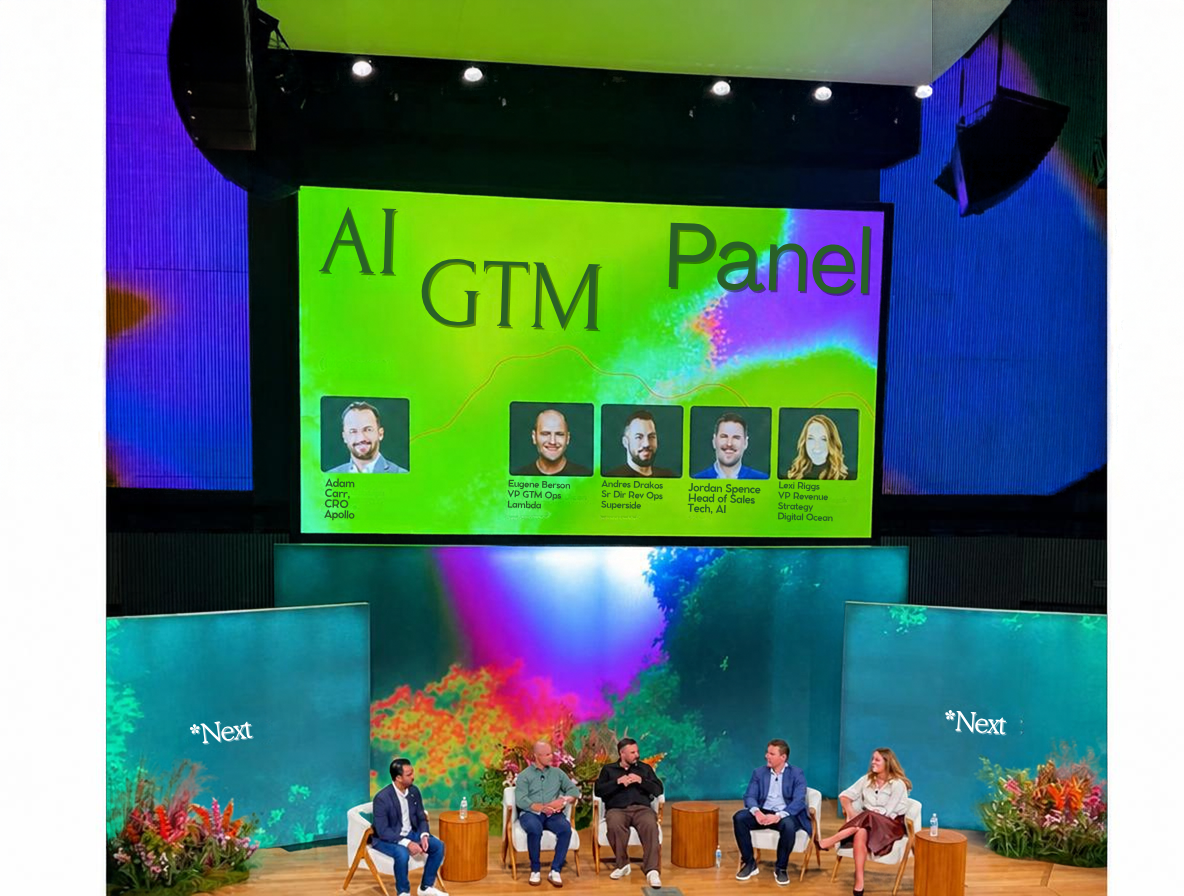
AI GTM Panel the Apollo Next a GTM Marketing Conference held annually in San Francisco.
I spent a morning listening to a panel of go-to-market leaders talk about where AI is taking sales and marketing. I walked in expecting a lot of "automate everything." I walked out with the opposite: the more AI can do, the more the human stuff matters.
First, a bit of context on the host. Apollo is a sales intelligence and engagement platform: a huge database of B2B contacts and companies, plus the tools to find, research, and reach them. I've used it personally to find customers for myself or my clients, dig into their data, and surface prospects I honestly didn't know I had. What's gotten really interesting is that it can now handle marketing too, so sales and marketing can finally live under one roof instead of in two disconnected stacks. On the panel, CEO Matt Curl shared that about two-thirds of their roughly 5M users have adopted the AI tooling they launched just a year ago.
Here's are my takeaways:
1. Bring your own ideas to AI. Jordan Spence (Head of Sales, Tech, AI) talked about manifestos for avoiding AI slop. The gist: don't use AI to check a box. Come with your own thinking, nail the brief, and remember there's a human on the receiving end. Test drive it, fact check it, and don't add to the 'slop cannon. Eugene Berson mentioned he flags in his Slack messages when something was written with AI. I love that as an emerging etiquette norm.
2. Personalization is now basically free, so it's no longer the differentiator. Outbound has become fundamentally easier. It's not just more emails, it's more personalized emails triggered by real buying signals. But when everyone can do that, it stops standing out. So the pendulum is swinging back toward in-person.
3. Cookies are a GTM strategy now. Seriously. Lexi Riggs (VP, Rev Strategy) was asked what's actually breaking through right now. Her answer: showing up at the office with cookies and asking for 15 minutes. Bringing something physical. Stepping outside email and LinkedIn entirely. The message that lands is "we actually thought about you," and it's hard to fake that with an email sequence.
4. Email might not last. One VP said his agent already tells him which emails to read and which to skip. Jordan agreed email isn't going to last forever. If an agent is filtering your prospect's inbox, your cold email strategy needs a rethink.
5. Know your ICP with data, not vibes. Get to a quantifiable ICP and clear triggers that make someone want to buy. Random outreach is expensive, and your finance team will tell you about as much.
6. The hack is the easy part. Lexi again: anyone can build a clever workflow. The real work is testing it, proving it's valuable, and then turning it into infrastructure. The panel kept coming back to this. Lots of individuals are building great things, but very few of those builds are actually scaling to teams or getting deployed across GTM.
7. Human judgment is the job now. AI is democratizing intelligence, which makes judgment the scarce skill. Knowing when a customer needs a phone call instead of another sequence isn't flashy, but it's where deals are won.
8. The "AI is cheap" era may not last. There's real concern that if open source models slow down, token costs could climb, and suddenly hiring a BDR looks like the economical choice again. Teams are already being asked to justify AI spend, frontier vs. open source. What's old is new again.
9. Just start. Rip the bandaid. Messy experimentation beats reading another LinkedIn post about AI (yes, I see the irony). One practical tip I'm stealing: block two hours of AI tinkering time and actually build something.
My big takeaway: AI is moving faster than anything, and the quality is genuinely good. But focus is the real advantage, and human connection is getting more valuable, not less.
So I'm curious: what do you think of all this? Are you seeing the swing back to in-person in your own pipeline? Would you bet on email being around in five years? Tell me in the comments.